
Part One: The Democratisation Lie

A Barn in Wales
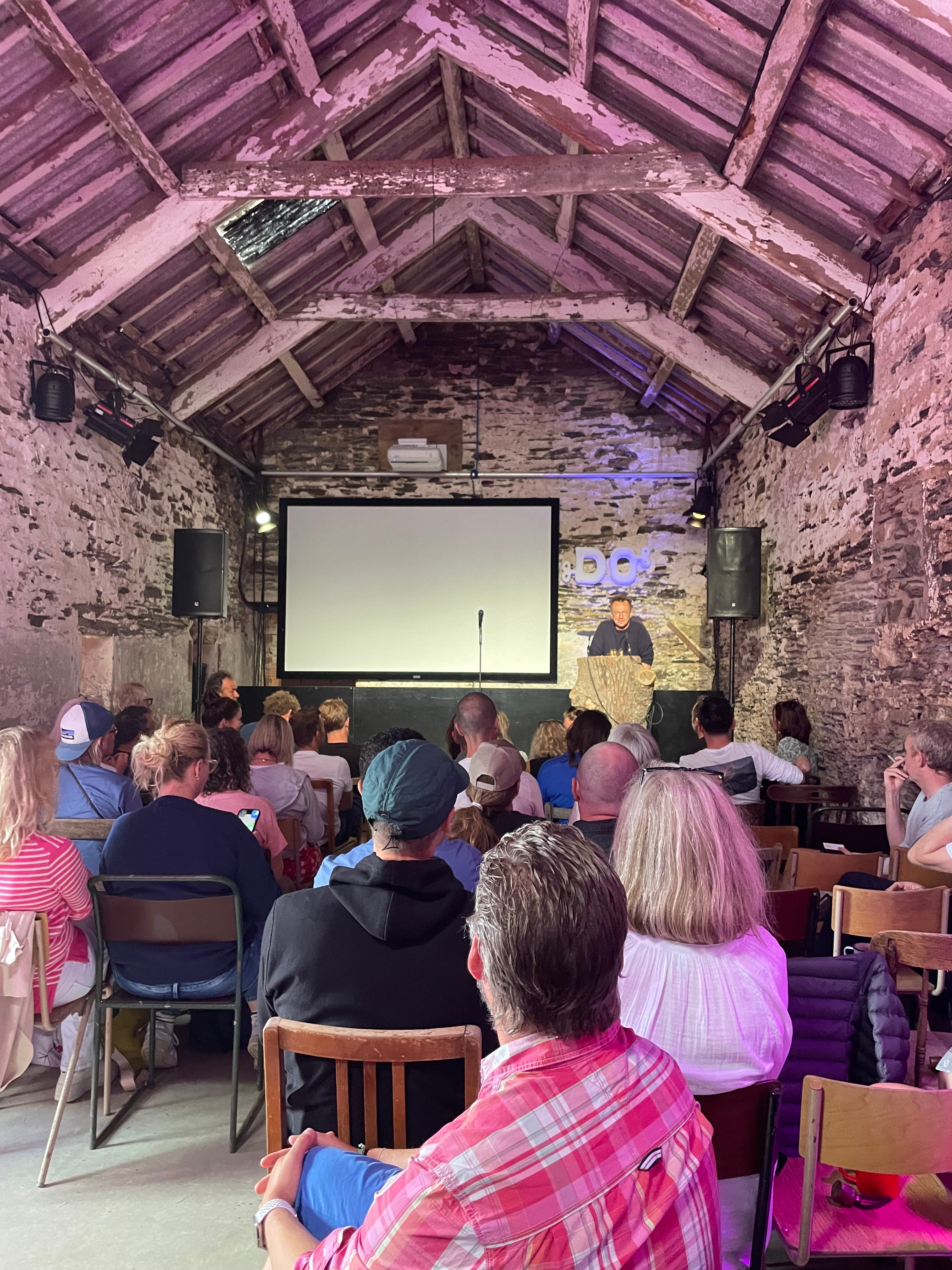
I was sitting in a cramped and very hot barn on the west coast of Wales when I first truly believed it.
It was July. I was at the Do Lectures. There was a visual artist on stage, speaking with a quiet conviction that made me lean forward in my seat. The weekend had already been full of ideas, the kind that rattle around in your head for days after. But this one landed differently.
He was talking about AI and creativity. Maybe the first time I’d heard the two words in a talk. And he was talking about what was coming with something close to joy. At the centre of his argument was a word I hadn’t heard used quite like this before.
Democratisation.
The idea that creativity, real creative expression, was about to become available to everyone. Not just those of us trained in it, shaped by years of expensive education, discipline, practice and failure. Everyone.
The two camps, he said, were about to dissolve. Those who are creative and those who aren’t. Gone. In their place, a world of diverse voices, each drawing on their own lived experience, their own way of seeing, using AI to bring it into being. Solutions we’d never dreamed of. A genuine widening of who gets to contribute to how the world is built and experienced.
I was relatively early in my own exploration of AI at that point. That barn felt like a threshold. Many of the talks that weekend centred around a new world that was inevitably changing and how we could ensure that change leaned towards the good. With that particular speaker, the uncertainty in me felt like possibility, and a possibility I could lean into.
I walked out energised in a way that’s hard to describe now. It felt scary and exciting in equal measure. The way the best ideas do when you haven’t yet had time to test them against reality.
I still think about that afternoon often.
What Actually Happened
The tools arrived. Access arrived. The barriers came down, just as promised.
And people did start making things. An enormous, accelerating, relentless volume of things.
But creative expression, the kind that draws on a unique perspective, that sits with a problem long enough to find something genuinely new, that didn’t democratise. What democratised was output. And output, it turns out, is not the same thing.
What I see most often now is work that is competent and interchangeable. Avatar versions of people, filtered into something that looks creative but contains no real thought. Mood boards assembled from other people’s aesthetics, processed into compositions that gesture toward originality without risking it. Work that arrived quickly, and it shows.
I’ve sat in enough rooms now to recognise the difference almost immediately. There’s a particular quality to work that has been generated rather than thought. It fits together too neatly. It hits recognisable reference points without ever quite committing to a position. It looks like creativity. It has none of the texture of it.
And the people presenting it often know it too. You can tell. There’s a certain distance between them and the work, as though they’re showing you something that arrived rather than something they made. The investment isn’t there. Because the thinking wasn’t there.
The promise was diverse voices using AI to express something true. The reality is a narrowing. A convergence toward whatever the tool finds most plausible, based on everything it has already seen.
Not democratisation. Replication at scale.
The Quiet Truth
Here is what I find more interesting than the slop itself.
While all of this was happening, something else was happening in parallel. Almost invisibly.
The people who already possessed deep craft, who had spent years learning how to think rigorously about a problem, who had developed the discipline to sit with complexity before reaching for a solution, those people were discovering that the tool worked differently for them. Not as a replacement for thinking. As an amplifier of it. A way to go further on ideas that already had real substance behind them.
The gap between them and everyone else didn’t close.
It widened.
And this is the part that interests me. Because it overturns something I genuinely believed standing in that barn in Wales. I thought AI would level the playing field. What I’m watching instead is the field tilting further toward those who were already ahead.
And as a creative professional I think this is what will define the future of our professions. Slop will quickly become tiresome, but craft will always hold value. Those who enhance their craft rather than abandon it will have something others simply can’t replicate.
The Return to Craft
The conversation about AI in the creative industries tends to focus on tools. Which ones to use. How to stay current. How to remain relevant.
But I think we’re asking the wrong question.
The right question isn’t how do we use AI. It’s what do we bring to it. Because the tool doesn’t create the thinking. It rewards thinking that’s already there.
In an earlier essay I wrote about the twenty percent. The part of creative work that remains irreducibly human. The ability to hold a client’s unspoken feeling about a space. The instinct that knows when something is wrong before it can be articulated. I still believe that’s true.
But I think the twenty percent is under pressure in a way I didn’t fully anticipate. Not from AI directly. From the subtle temptation to skip the thinking that produces it. We are, whether we like it or not, in the middle of the Slop Years. The question is what you do with them.
Which means the most important investment a creative can make right now has nothing to do with software.
It has everything to do with craft.
In the next essay I want to explore what craft actually means now. Not technique. Not style. Something harder to name, and more important than either. And in the third, what this demands of us practically. Because if AI is concentrating creative advantage rather than spreading it, that changes everything about how we invest in ourselves, our teams, and the work we choose to do.
Until next time, Deepak
Honing my craft.
Want weekly insights on staying irreplaceable in an AI world? Subscribe to The Creative Frontier.
Connect with me on LinkedIn
http://linkedin.com/in/deepak-parmar-bbb8a81a
P.S. If this resonates, share it with another creative who’s ready to think differently about AI.